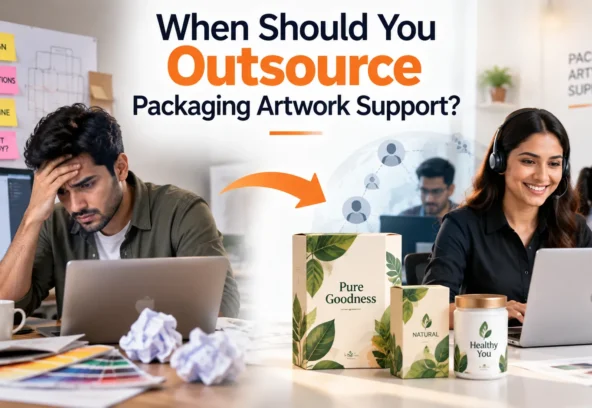

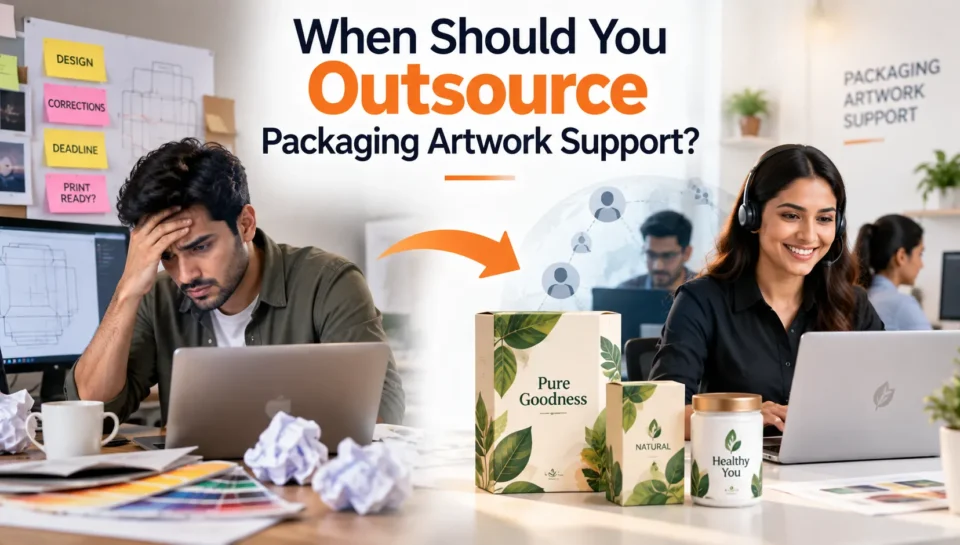
You should consider outsourcing packaging artwork support when your internal design team is struggling with production deadlines, multiple SKUs, frequent artwork revisions, technical prepress requirements, or printer-specific file preparation.
Packaging artwork is more than making a product look attractive. The final file has to work across design, printing, finishing, regulatory requirements, dielines, colour management, and production. Adobe describes packaging as a specialised workflow that requires collaboration between designers, prepress specialists, printers, converters, and other stakeholders.
For growing brands, agencies, FMCG companies, and manufacturers, outsourcing packaging artwork support can provide additional production capacity without requiring a permanent in-house artwork team.
Quick Answer: When Should You Outsource Packaging Artwork?
Outsourcing makes sense when you need specialised packaging artwork expertise, additional production capacity, faster artwork adaptation, or reliable prepress support.
Common situations include:
- You have multiple packaging SKUs to update.
- Your team is overloaded with artwork revisions.
- Packaging needs to be adapted for different sizes or markets.
- Designers are spending too much time on production tasks.
- Printer specifications vary between projects.
- You need dieline, bleed, colour, or finishing preparation.
- You are launching several products simultaneously.
- Your agency needs a reliable white-label artwork partner.
- You want to reduce avoidable artwork errors before printing.
The important point is that outsourcing does not necessarily mean outsourcing the entire creative process. Many businesses keep brand strategy and creative direction in-house while outsourcing the production artwork and prepress stage.
What Is Packaging Artwork Support?
Packaging artwork support is the production-focused stage between approved design and manufacturing.
It can include:
- Artwork adaptation
- Packaging file preparation
- Dieline setup
- Bleed and safe-area management
- Colour conversion and checking
- Typography corrections
- Image placement
- Vector artwork preparation
- Barcode and QR-code placement
- Multi-SKU adaptation
- Language or market adaptations
- Printer-specific file preparation
- Special-finish layers
- Preflight checks
- Print-ready PDF creation
- Artwork corrections after printer feedback
The exact scope depends on the packaging format and production process.
HP’s packaging workflow documentation, for example, highlights the need to manage cutting paths, crease paths, registration marks, and bleed when preparing packaging files.
1. When Your Team Has Too Many SKUs
One of the clearest signs that you may need external packaging artwork support is SKU growth.
A single packaging concept can quickly become dozens of production files:
1 design → multiple sizes → multiple flavours → multiple languages → multiple markets → multiple print specifications
The creative design may remain largely the same, but every variation still needs to be checked.
For example, a food brand could have separate artwork for:
- 100 g
- 250 g
- 500 g
- 1 kg
- Different flavours
- Different languages
- Different countries
Doing every adaptation manually can consume significant design-team time.
An artwork support team can handle these production variations while the internal team concentrates on higher-value creative and strategic work.
2. When Designers Are Spending Too Much Time on Production Work
Your creative designers should not necessarily spend most of their day fixing technical artwork.
If experienced designers are repeatedly working on:
- Bleed adjustments
- Dieline placement
- File corrections
- Text alignment
- Version updates
- Packaging resizing
- Printer corrections
- Export problems
you may be using creative resources for production-heavy tasks.
Outsourcing these activities can create a clearer division:
Internal team: brand strategy, concepts, creative direction and approvals.
Artwork partner: adaptations, technical preparation, prepress and production files.
This can be particularly useful for agencies managing several packaging clients simultaneously.
3. When You Have Tight Packaging Deadlines
Packaging launches often involve multiple parties working against the same deadline.
The sequence may look like:
Design approval → artwork adaptation → internal review → client approval → printer review → corrections → final prepress → production
A delay at one stage can affect everything that follows.
Adobe notes that packaging projects often require repeated review, approval and revision cycles before reaching production.
If your internal team cannot handle additional production volume during a launch, an external artwork team can provide temporary or ongoing capacity.
4. When Packaging Requires Technical Prepress Expertise
Not every graphic designer works extensively with commercial packaging production.
Packaging can involve technical considerations such as:
- CMYK and spot colours
- Colour separations
- Overprinting
- Trapping
- Bleed
- Dielines
- Cut and crease paths
- Varnish
- Foil
- Embossing
- Print specifications
Adobe explains that commercial printing can involve CMYK colour separations as well as additional plates for spot colours and special coatings.
Similarly, overprint settings can affect how overlapping colours reproduce on press, making technical artwork checks important before production.
If your team does not regularly manage these requirements, specialised packaging artwork support can fill that gap.
5. When You Work With Multiple Printers
Different printers and converters may have different file requirements.
One supplier might request a particular PDF standard, while another may provide its own specifications for:
- Bleed
- Colour profiles
- Dielines
- Spot colours
- Fonts
- File naming
- Finishing layers
- Proofing
This becomes more complicated when a brand operates across different countries or packaging formats.
A production artwork partner can help adapt approved artwork according to the relevant printer’s specifications rather than forcing your creative team to learn every production workflow from scratch.
6. When You Need Faster Multi-Market Adaptation
International brands frequently need packaging adapted for different markets.
The artwork may require changes to:
- Language
- Product claims
- Legal information
- Ingredients
- Regulatory information
- Measurements
- Barcode
- Contact information
- Local distributor details
The creative concept may stay consistent while the production artwork changes.
Adobe’s packaging guidance also highlights the importance of clear labelling, brand consistency and legal or mandatory information in packaging design.
This makes structured artwork management especially valuable for brands operating across multiple regions.
7. When Printer Corrections Keep Coming Back
Repeated printer corrections are another practical signal.
For example:
“Please fix the bleed.”
“The dieline is incorrect.”
“This spot colour is missing.”
“The font needs to be outlined.”
“Please adjust the overprint.”
“The image resolution is insufficient.”
These corrections can delay production and create unnecessary communication between the brand, designer and printer.
A dedicated prepress review before submission can identify many technical issues earlier.
Adobe’s current InDesign workflow recommends running preflight and checking issues such as missing fonts and linked graphics before packaging files for output.
8. When You Are Launching a New Product Line
A new product launch often creates a temporary increase in artwork workload.
You may suddenly need:
- Primary packaging
- Secondary packaging
- Labels
- Cartons
- Multipacks
- Promotional packaging
- Display units
- Multiple product variants
Instead of hiring permanent staff for a temporary workload increase, outsourcing can provide additional production capacity during the launch period.
This is particularly useful when the brand already has an internal creative team but needs additional hands for execution.
What Should You Outsource?
Not every packaging task needs to be outsourced.
A practical approach is to keep brand-critical decisions internally and outsource repetitive or technically specialised production tasks.
| Keep In-House | Consider Outsourcing |
| Brand strategy | Artwork adaptation |
| Creative direction | Multi-SKU production |
| Packaging concept | Prepress preparation |
| Brand identity | Dieline setup |
| Key visual decisions | Printer corrections |
| Final approvals | Print-ready file preparation |
| Campaign direction | Version management |
This approach gives the internal team control over the brand while allowing specialists to manage production-heavy work.
How to Choose a Packaging Artwork Support Partner
Before outsourcing, check whether the provider understands both design and print production.
Ask about:
- Packaging industry experience
- Prepress capabilities
- Multi-SKU adaptation
- Dieline handling
- Colour management
- Print-ready PDF preparation
- Experience with different printers
- Revision management
- File organisation
- Quality-control procedures
You should also establish a clear approval process.
A good workflow can be:
Brief → Source files → Artwork adaptation → Internal QC → Client approval → Prepress check → Printer submission
This reduces ambiguity about who is responsible for each stage.
How Langoor Designs Can Support Packaging Artwork Production
Langoor Designs positions itself around production-ready design, with its website showcasing packaging, production perfection, utility-focused design and strategic brand design.
For brands and agencies that already have an approved packaging concept, a production-focused partner can help convert that design into artwork that is organised and prepared for manufacturing.
The company showcases experience across packaging categories and reports 13+ years, 50+ markets, 500+ projects and 100+ production-ready projects on its website.
This type of production support can be particularly useful when a brand has several packaging variations, frequent artwork updates or international production requirements.
The objective is not simply to outsource design. It is to create a reliable bridge between approved creative artwork and production-ready files.
Frequently Asked Questions
What is packaging artwork outsourcing?
Packaging artwork outsourcing means hiring an external specialist or team to handle production-related packaging tasks such as adaptations, prepress, dielines, file preparation, revisions and print-ready artwork.
When should a small business outsource packaging artwork?
A small business can consider outsourcing when it does not have an experienced packaging production designer internally or when packaging projects are becoming too technical or time-consuming for its existing team.
Is packaging artwork the same as packaging design?
No. Packaging design generally focuses on the visual and strategic concept, while packaging artwork involves preparing that approved design for actual production.
Can agencies outsource packaging artwork?
Yes. Agencies can outsource packaging artwork production when they need additional capacity, specialist prepress skills or white-label production support.
Does outsourcing packaging artwork reduce printing errors?
It can help identify technical issues before production when the outsourced team follows an appropriate prepress and quality-control process. However, the result depends on the provider’s workflow, the printer’s specifications and the quality of the supplied artwork.
Can packaging artwork support handle multiple SKUs?
Yes. Multi-SKU adaptation is one of the common reasons companies use external artwork production teams.
Should packaging design or artwork production be outsourced first?
It depends on the company’s workflow. A business can keep creative direction and brand strategy internally while outsourcing production artwork, or it can outsource both if it needs broader packaging support.