
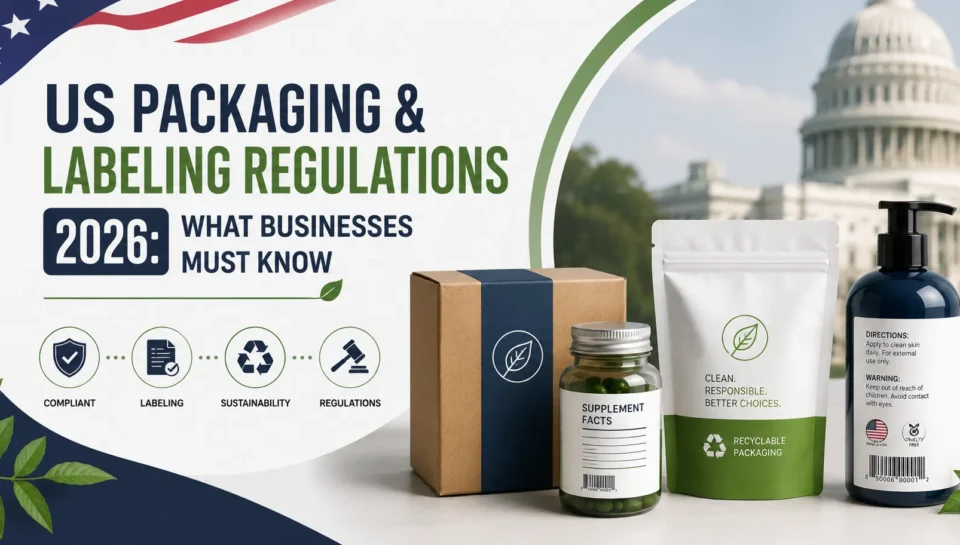
If your business manufactures, imports, or sells products in the United States, staying compliant with packaging and labeling regulations isn’t optional it’s essential. Whether you’re launching a food product, cosmetic, dietary supplement, medical device, or consumer packaged good (CPG), non-compliant packaging can lead to delayed shipments, rejected retail listings, product recalls, regulatory action, and damage to your brand reputation.
In 2026, packaging compliance is becoming more complex as businesses prepare for evolving requirements, including FDA labeling updates, sustainability expectations, and the industry’s transition toward GS1 2D barcodes under the Sunrise 2027 initiative.
This guide explains the key US packaging and labeling regulations businesses should understand, how to prepare compliant packaging, and why partnering with an experienced packaging design agency can reduce risk and streamline product launches.
Quick Overview
Businesses selling products in the US should focus on these key compliance areas:
- FDA labeling requirements
- Product-specific packaging regulations
- Nutrition and ingredient declarations
- Allergen labeling
- Country of origin requirements
- Barcode compliance
- GS1 2D barcodes
- Sunrise 2027 readiness
- Packaging artwork accuracy
- Print-ready regulatory compliance
Understanding these areas early helps businesses avoid costly redesigns and production delays.
Why Packaging Compliance Matters
Packaging is more than branding and product protection. It is also a legal document that communicates critical information to regulators, retailers, distributors, and consumers.
Compliant packaging helps businesses:
- Meet legal requirements
- Build consumer trust
- Reduce recall risks
- Improve retailer acceptance
- Avoid customs delays
- Support product traceability
Even small artwork mistakes can result in significant financial consequences.
Understanding FDA Labeling Requirements
For products regulated by the U.S. Food and Drug Administration (FDA), labels must provide accurate, truthful, and clearly presented information.
Depending on the product category, FDA labeling requirements may include:
- Product identity
- Net quantity of contents
- Ingredient list
- Nutrition Facts panel
- Allergen declarations
- Manufacturer or distributor information
- Directions for use
- Warning statements
- Storage instructions
Labels must not contain misleading claims or omit mandatory information.
Businesses should always review product-specific FDA requirements before finalizing packaging artwork.
Food Packaging Requirements
Food packaging is one of the most highly regulated categories in the United States.
Common labeling requirements include:
Product Name
The product identity must clearly describe the food.
Nutrition Facts Panel
Packaged foods generally require a compliant Nutrition Facts label.
Ingredient List
Ingredients must be listed in descending order by weight.
Major Food Allergens
Certain allergens must be clearly declared to help protect consumers.
Net Quantity Statement
The amount of product inside the package must be accurately displayed using approved units.
These elements should be incorporated into packaging artwork from the beginning of the design process.
Cosmetic Labeling Requirements
Cosmetic products sold in the United States typically require packaging that includes:
- Product identity
- Net contents
- Ingredient declaration
- Responsible business information
- Warnings when applicable
- Directions for safe use
Claims such as “organic,” “natural,” or “chemical-free” should be used carefully and supported where required.
Dietary Supplements and Healthcare Products
Supplement packaging often requires additional information such as:
- Supplement Facts panel
- Serving size
- Active ingredients
- Daily values
- Usage instructions
- Warning statements
- Storage recommendations
Healthcare products may also require additional regulatory information depending on product classification.
Country of Origin Requirements
Imported products often require country-of-origin marking.
Examples include:
- Made in India
- Made in UK
- Made in Germany
Country-of-origin labeling helps customs authorities and consumers identify where products were manufactured.
Businesses exporting to the United States should verify applicable import requirements before production.
Barcode Compliance Is Becoming More Important
Retailers depend on accurate barcode systems for inventory management and checkout.
Incorrect barcode placement or formatting can result in:
- Retail rejection
- Distribution delays
- Inventory issues
- Customer service problems
Every barcode should be tested before final production.
What Are GS1 2D Barcodes?
Traditional one-dimensional barcodes primarily store a product identification number.
GS1 2D barcodes can store significantly more information, including:
- Product identification
- Batch numbers
- Expiration dates
- Serial numbers
- Manufacturing details
- Website links
- Authentication information
This additional data supports improved supply chain visibility and customer engagement.
Understanding Sunrise 2027
One of the most significant developments affecting packaging is the Sunrise 2027 initiative.
Sunrise 2027 is a global industry initiative led by GS1 encouraging retailers and brands to prepare checkout systems capable of scanning both traditional barcodes and GS1 2D barcodes at point of sale.
For businesses, this means now is the ideal time to begin planning packaging updates rather than waiting until the final implementation period.
Preparing early allows brands to:
- Avoid future redesign costs
- Improve traceability
- Support product authentication
- Enable richer digital experiences
- Strengthen supply chain efficiency
Although adoption timelines vary by retailer and product category, businesses should begin evaluating how GS1 2D barcodes fit into future packaging strategies.
Sustainability and Packaging Compliance
Consumers increasingly expect environmentally responsible packaging.
Many businesses are adopting:
- Recyclable materials
- Lightweight packaging
- Minimal packaging designs
- Paper-based alternatives
- Refillable packaging
Sustainability claims should always be accurate and substantiated to avoid misleading consumers.
Clear disposal and recycling instructions also improve customer experience.
Common Packaging Compliance Mistakes
Many packaging issues arise from avoidable mistakes.
Common examples include:
Incorrect Ingredient Lists
Outdated formulations appearing on packaging.
Missing Mandatory Information
Required warnings or declarations omitted.
Artwork Version Errors
Using outdated packaging files.
Barcode Problems
Unreadable or incorrectly positioned barcodes.
Unsupported Marketing Claims
Claims that cannot be substantiated.
Typography Issues
Small or illegible regulatory text.
A structured artwork review process significantly reduces these risks.
Best Practices for Compliant Packaging
Businesses can improve compliance by following several practical steps.
Involve Regulatory Teams Early
Compliance should begin before design work starts.
Maintain Artwork Version Control
Use clear approval systems to prevent outdated files from reaching production.
Use Professional Prepress Checks
Verify technical accuracy before printing.
Validate Barcodes
Ensure all codes scan successfully.
Review Product Claims
Marketing statements should be supported by appropriate evidence.
Prepare for Future Packaging Changes
Consider how packaging may need to evolve with future regulations and technologies.
Why Packaging Artwork Is Just as Important as Design
Many businesses focus heavily on visual design while overlooking artwork production.
Packaging artwork ensures:
- Mandatory information is included
- Layout follows printer specifications
- Barcodes function correctly
- Regulatory text remains readable
- Files are production-ready
Strong artwork management helps reduce production delays and compliance risks.
How Langoor Designs Helps Businesses Prepare Compliant Packaging
Creating compliant packaging requires more than creative design. It requires a detailed understanding of production processes, artwork preparation, and regulatory considerations.
With more than 13 years of experience, 500+ completed packaging projects, and clients across 50+ global markets, Langoor Designs helps businesses develop production-ready packaging for domestic and international markets.
Their expertise includes:
- Packaging Design Services
- Packaging Artwork Production
- FDA-Compliant Packaging Layout Support
- Label Design
- Print-Ready Artwork
- Prepress Services
- Packaging Adaptation
- GS1 Barcode Integration
- Packaging for FMCG, Healthcare, Cosmetics, and Consumer Products
By combining creative excellence with technical accuracy, Langoor Designs helps brands reduce production errors, improve packaging consistency, and prepare for future industry developments such as GS1 2D barcodes and Sunrise 2027.
Frequently Asked Questions
What are US packaging regulations?
US packaging regulations include requirements related to product labeling, ingredient declarations, nutrition information, warnings, barcodes, and other mandatory information depending on the product category.
What are FDA labeling requirements?
FDA labeling requirements vary by product type but generally include product identity, ingredient information, net quantity, manufacturer details, directions, and applicable warning statements.
What is Sunrise 2027?
Sunrise 2027 is a GS1-led industry initiative encouraging retailers and brands to prepare checkout systems capable of scanning GS1 2D barcodes alongside traditional linear barcodes.
What are GS1 2D barcodes?
GS1 2D barcodes are advanced barcodes capable of storing additional product information such as batch numbers, expiry dates, serial numbers, and digital links.
Do all businesses need GS1 2D barcodes?
Not immediately. However, businesses should begin planning for future adoption, particularly if they supply major retailers or operate in highly regulated industries.
Why should businesses work with a packaging design agency?
A professional packaging design agency helps create packaging that is visually appealing, production-ready, technically accurate, and better prepared for evolving compliance requirements.
Final Thoughts
Packaging compliance is becoming increasingly important as businesses navigate changing regulations, evolving retailer expectations, and growing consumer demand for transparency.
Understanding US packaging regulations, meeting FDA labeling requirements, and preparing for initiatives such as Sunrise 2027 and GS1 2D barcodes can help businesses reduce risk while creating future-ready packaging.
Rather than viewing compliance as a limitation, forward-thinking companies treat it as an opportunity to improve customer trust, strengthen operational efficiency, and build a more resilient brand. By combining strategic packaging design with accurate artwork production and regulatory planning, businesses can confidently bring products to the US market while staying prepared for the next generation of packaging standards.