
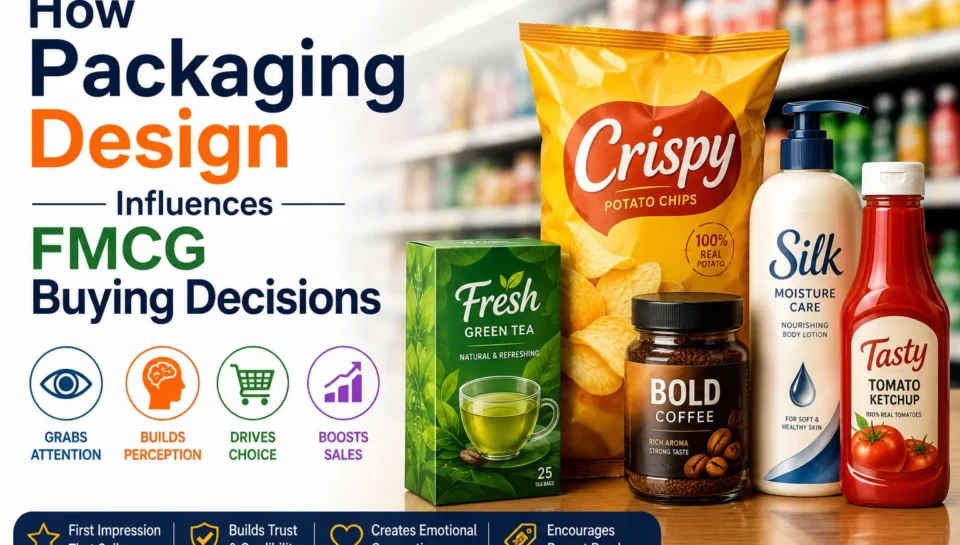
Walk through any supermarket and you will see hundreds of products competing for attention. Most shoppers aren’t studying every package carefully. They scan shelves, recognise familiar brands, notice colours and images, compare a few options, and make decisions quickly.
That makes packaging much more than a protective covering.
For FMCG brands, packaging is often one of the most important marketing touchpoints at the exact moment a consumer is deciding what to buy. Research using eye-tracking has found that package design features influence visual attention during in-store product searches, while factors such as shape and contrast can be particularly important during the initial search stage.
This is why effective FMCG packaging design needs to do more than look attractive. It needs to attract attention, communicate the product clearly, create the right expectations, establish trust, and make the buying decision easier.
Quick Answer: How Does Packaging Design Influence Buying Decisions?
Packaging design influences FMCG buying decisions by affecting what consumers notice first, how they perceive the product, what they expect from it, and how easily they can compare it with competing products.
Elements such as colour, typography, imagery, package shape, brand recognition, product information, claims, and visual hierarchy can all contribute to the consumer’s perception of a product.
However, attractive packaging alone does not guarantee a purchase. Effective packaging needs to combine visual attention with clear communication, brand relevance, product expectations, and usability.
Why Packaging Matters So Much for FMCG Products
FMCG products are often purchased in environments where consumers have many alternatives immediately in front of them.
Think about a supermarket shelf containing 20 different snack products. A consumer may not have the time or motivation to read every label.
The package therefore has to communicate quickly:
What is this?
Who makes it?
What makes it different?
Why should I consider it?
Is it right for me?
Research on grocery shopping has found that consumers’ visual attention is fragmented by the large number of stimuli in stores, making packaging design an important part of the visual search process.
This is where strategic packaging design becomes valuable.
1. Packaging Creates the First Visual Impression
Before a consumer reads the ingredients or compares prices, they see the package.
That first visual impression can influence whether they pick up the product, ignore it, or move on to another option.
A strong package creates a clear visual hierarchy so the most important information is immediately visible.
For example, a snack package might prioritise:
Brand → Product Type → Flavour → Key Benefit
A poorly structured package may contain the same information but make the consumer work harder to find it.
In a crowded retail environment, that difference matters.
2. Colour Can Attract Attention and Set Expectations
Colour is one of the most powerful elements in packaging design.
It can help a product stand out while also communicating an intended personality or product expectation.
For example, brands may use colour to suggest:
- Freshness
- Energy
- Premium quality
- Natural ingredients
- Indulgence
- Simplicity
- Trust
- Youthfulness
Research on food, beverage, and home and personal care packaging describes colour as an important cue for attracting attention and shaping expectations about products and brands.
But there is an important lesson here: there is no universally “best” packaging colour.
Colour needs to make sense for the category, audience, brand identity, and positioning.
3. Typography Helps Consumers Understand the Product
Typography isn’t just about making packaging look stylish.
It affects how quickly consumers can understand what they’re looking at.
Imagine two products on a shelf.
One has a clear product name that can be read from a distance.
The other uses decorative typography where the product name is difficult to identify.
Even if the second package is more visually sophisticated, the first may communicate more effectively.
Good FMCG packaging typography should establish a clear information hierarchy.
The consumer should be able to distinguish:
- Brand name
- Product name
- Variant or flavour
- Key benefit
- Important supporting information
The objective is simple: make the important information easy to find.
4. Packaging Images Shape Product Expectations
Images can communicate a product before the consumer reads the copy.
A photograph of fresh ingredients may create expectations of freshness. A premium product image may suggest quality. A lifestyle image can communicate how the product fits into everyday life.
Research into food packaging has found that visual attributes such as colour and shape can influence product expectations, preferences, and associations with characteristics such as taste and healthiness.
This is why imagery needs to be carefully selected.
A beautiful image that creates the wrong expectation can actually work against the product.
5. Package Shape Can Influence Perception
Shape is another element that consumers notice quickly.
Packaging can feel:
- Premium
- Friendly
- Modern
- Traditional
- Natural
- Convenient
- Functional
depending on its physical structure and visual form.
Research examining food packaging has found that package shape can influence consumer expectations and preferences alongside colour and product category.
For FMCG brands, this means packaging structure should not be treated separately from branding.
The physical package is part of the brand experience.
6. Packaging Helps Consumers Recognise Brands
Strong FMCG brands often become recognisable through consistent visual assets.
These can include:
- Signature colours
- Logos
- Typography
- Illustrations
- Patterns
- Product architecture
- Distinctive layouts
Over time, these elements can become visual shortcuts.
A consumer may recognise a brand before consciously reading its name.
This is particularly important for FMCG companies with multiple products because packaging needs to balance brand consistency with product differentiation.
A new product should look like it belongs to the same brand family without becoming indistinguishable from existing products.
7. Packaging Communicates Product Benefits Quickly
Consumers often want to know what makes a product worth choosing.
Packaging can communicate benefits through concise messages such as:
- High protein
- Sugar-free
- Organic
- Extra strength
- Natural ingredients
- Ready to eat
- Long-lasting
- Dermatologically tested
The challenge is deciding which information deserves visual priority.
Too little information may leave consumers uncertain.
Too much information can create visual clutter.
Effective packaging design finds the balance between information and simplicity.
8. Packaging Can Build Trust
Consumers don’t only evaluate what a product promises. They also evaluate whether the package feels credible.
Professional photography, consistent typography, clear information, quality materials, and thoughtful design can contribute to perceived product quality.
This is particularly important for categories where consumers are cautious about what they purchase.
At the same time, brands should avoid making packaging claims that are misleading or unsupported.
Good design should strengthen trust not manufacture it through visual tricks.
9. Packaging Makes Comparison Easier
FMCG shoppers frequently compare several products before purchasing.
They may compare:
- Price
- Quantity
- Flavour
- Ingredients
- Benefits
- Brand
- Packaging size
- Product claims
Packaging should make these comparisons easy.
For example, if a consumer is looking for a particular flavour, that information should be immediately visible.
If the product has a significant differentiator, it should not be hidden in tiny text on the back.
Good packaging reduces the amount of mental effort required to understand the product.
10. Shelf Standout Is Important but Not Everything
One common packaging mistake is focusing entirely on being different.
Yes, packaging needs to stand out.
But different doesn’t automatically mean effective.
A package might be extremely colourful and attract attention but fail to communicate what the product actually is.
Research shows that visual salience can attract attention without necessarily translating directly into purchase motivation. A 2025 study on packaging colour, for example, found that attention and purchase intention are not identical outcomes and that factors such as trust and perceived suitability can mediate the relationship.
The goal isn’t simply:
“Make people look.”
It is:
“Make the right people notice, understand, trust, and consider the product.”
11. Packaging Influences Impulse Purchases
FMCG categories often include products purchased with limited planning.
Snacks, beverages, confectionery, personal care products, and household items can all involve spontaneous purchase decisions.
In these situations, packaging can become particularly important because consumers may not have a detailed product comparison prepared in advance.
A clear brand cue, appealing visual, relevant benefit, and easy-to-understand product proposition can help influence the final consideration.
This is one reason packaging should be designed around actual consumer behaviour rather than only internal brand preferences.
12. Packaging Needs to Work Across Physical and Digital Retail
The role of FMCG packaging is no longer limited to supermarket shelves.
Consumers also encounter packaging through:
- E-commerce listings
- Social media
- Online advertisements
- Product reviews
- Influencer content
- Brand websites
A package that looks strong physically should also remain recognisable when photographed or displayed as a small product thumbnail.
This creates another challenge for modern packaging designers: design for the shelf, but don’t forget the screen.
How FMCG Brands Can Create More Effective Packaging
A practical approach is to build packaging around five questions:
1. Who is the target consumer?
Understand their needs, expectations, preferences, and shopping behaviour.
2. What should they notice first?
Identify the single most important visual or message.
3. What should they understand immediately?
Make the product category and core proposition clear.
4. Why should they choose this product?
Highlight a meaningful differentiator.
5. What should they remember?
Build distinctive brand assets that can create recognition over time.
This approach creates packaging that is not only attractive but commercially purposeful.
Common FMCG Packaging Design Mistakes
Even experienced brands can make packaging mistakes.
Some of the most common include:
- Too much information
- Weak visual hierarchy
- Poor colour contrast
- Difficult-to-read typography
- Generic imagery
- Inconsistent SKU design
- Lack of shelf differentiation
- Overuse of design elements
- Unclear product benefits
- Ignoring the physical package structure
- Designing without competitor context
The solution isn’t always to add more design.
Sometimes the best improvement is removing unnecessary elements and making the important information more obvious.
How Langoor Designs Helps FMCG Brands
For FMCG companies, packaging design needs to connect brand strategy, consumer behaviour, visual communication, and production requirements.
This is where an experienced packaging design agency can add value.
Langoor Designs, shown in the supplied company reference, focuses on production-ready packaging design and artwork for brands across multiple markets. The company’s presentation highlights 13+ years of experience, 50+ markets, 500+ projects, and 100+ production-ready projects.
Its capabilities include:
- FMCG Packaging Design
- Strategic Brand Design
- Packaging Artwork
- Print-Ready Artwork
- Prepress Services
- Label Design
- SKU Adaptation
- Production Support
For an FMCG brand, the goal should not simply be to create packaging that looks attractive in a design presentation.
It should be packaging that gets noticed, communicates quickly, supports brand recognition, and can ultimately move smoothly into production.
That combination of strategic design and production expertise can make packaging a much stronger part of the overall marketing system.
Frequently Asked Questions
How does packaging design affect FMCG buying behaviour?
Packaging can influence what consumers notice, how they perceive the product, what they expect from it, and how easily they compare it with alternatives. Colour, shape, typography, imagery, brand cues, and information hierarchy all contribute to the overall experience.
Which packaging element influences consumers the most?
There isn’t one universal element that works best for every product. Colour, shape, imagery, typography, brand recognition, and product information can all influence perception. Their effectiveness depends on the category, audience, positioning, and retail environment.
Does attractive packaging increase sales?
Attractive packaging can help a product gain attention and create positive expectations, but appearance alone doesn’t guarantee sales. Packaging needs to communicate the product clearly and support the brand’s value proposition.
Why is colour important in FMCG packaging?
Colour can attract attention, differentiate a brand, and create associations about qualities such as freshness, premium positioning, energy, or naturalness. Research also shows that colour can influence product expectations and consumer responses.
Should FMCG packaging be simple or detailed?
It depends on the product and audience. The priority should be clarity. A simple design can work extremely well when it communicates the brand and product proposition clearly, while some categories may require more information.
How can a packaging design agency help an FMCG brand?
A packaging design agency can combine consumer research, brand strategy, visual design, packaging structure, SKU systems, artwork production, and prepress knowledge to create packaging that is both commercially effective and production-ready.