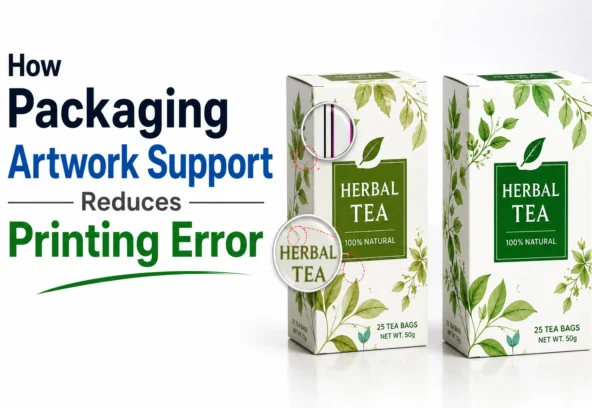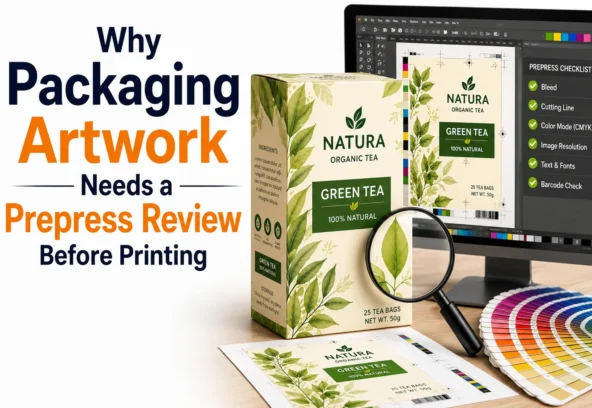

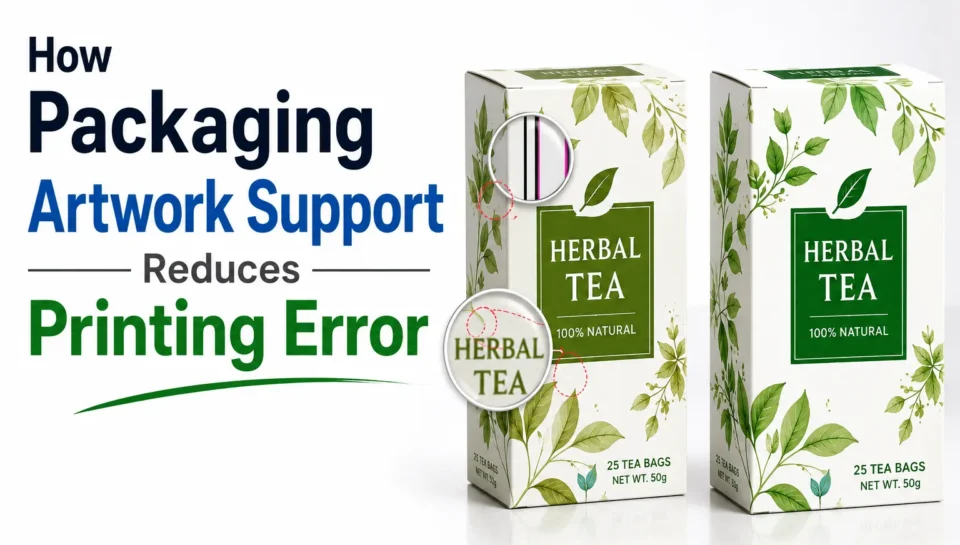
A packaging design can look perfect on a computer screen and still fail when it reaches the printing press.
Wrong colours, missing bleed, incorrect dielines, low-resolution images, misplaced barcodes, missing fonts, or outdated product information can turn an approved design into an expensive production problem. For brands managing multiple SKUs, languages, markets, or packaging formats, these risks become even harder to control.
This is where packaging artwork support becomes important.
Packaging artwork support acts as the technical bridge between an approved packaging design and the final production file. A strong artwork and prepress process checks the details that are easy to overlook during the creative stage and helps identify problems before they reach the printer. Industry prepress checklists consistently highlight dielines, bleed, colour, fonts, image resolution, barcodes, version control, and finishing layers as critical checks before production.
Quick Answer: How Does Packaging Artwork Support Reduce Printing Errors?
Professional packaging artwork support reduces printing errors by checking artwork against the manufacturer’s specifications before production. This can include verifying dielines, bleed, colour profiles, image resolution, fonts, barcodes, regulatory copy, finishing instructions, file versions, and final PDF settings.
The objective is simple: catch the error on screen before it becomes a problem on the printing press.
What Is Packaging Artwork Support?
Packaging artwork support is the technical production service that prepares, checks, adapts, and manages packaging files before they are sent for printing.
It is different from creating the original packaging concept.
A designer may develop the visual identity, typography, imagery, colours, and overall packaging layout. The artwork team then makes sure that approved design works correctly within the actual production specifications.
This can involve:
- Applying artwork to the approved dieline
- Checking dimensions and panel orientation
- Setting up bleed and safe areas
- Checking colour modes and spot colours
- Reviewing image resolution
- Managing fonts and linked assets
- Checking barcodes and QR codes
- Preparing special-finish layers
- Managing SKU adaptations
- Performing prepress quality checks
- Creating production-ready files
In other words, artwork support turns “the design is approved” into “the file is ready for production.”
1. Correct Dielines Prevent Structural Problems
The dieline is one of the most important elements of packaging artwork.
It defines where the packaging will be cut, folded, sealed, glued, perforated, or otherwise converted. Artwork should be built on the correct supplier-approved dieline rather than an estimated or outdated template.
If the wrong dieline is used, problems can include:
- Logos crossing folds
- Text being cut off
- Graphics becoming misaligned
- Artwork appearing upside down
- Glue areas being printed incorrectly
- Panels not matching the finished structure
Professional artwork support checks the artwork against the latest production geometry before the file moves forward.
2. Bleed and Safe Areas Reduce Cutting Problems
Printing and converting involve physical processes with tolerances. Artwork therefore needs enough bleed beyond the final trim edge, while important information should remain inside the safe area.
The exact bleed requirement should always come from the printer or packaging manufacturer because specifications vary by product and process. A common packaging specification is 3 mm, but it should not be treated as a universal rule.
Artwork support checks that:
- Backgrounds extend beyond the cut line
- Important text stays away from trim edges
- Logos remain clear of folds
- Barcodes are positioned correctly
- Critical information does not fall into glue or seal areas
These checks help prevent avoidable trimming and finishing problems.
3. Colour Management Helps Prevent Colour Surprises
The colour you see on a monitor is not necessarily the colour that will appear on printed packaging.
Packaging artwork may involve CMYK process colours, spot colours, Pantone references, white ink, metallic substrates, varnishes, or other production-specific requirements.
A professional prepress review checks whether the colour setup matches the intended printing process. Packaging preflight guidance commonly recommends checking CMYK or appropriate spot-colour setups and clearly separating special production layers.
This is particularly important for brands with strict colour identities.
A small colour variation may be acceptable for one project but unacceptable for a brand whose packaging depends on consistent colour recognition across hundreds of SKUs.
4. Image Resolution Checks Prevent Blurry Packaging
Images that look sharp on a website may not be suitable for large-format or high-quality packaging production.
Artwork support checks the effective resolution of placed images at their final size. A common production guideline is around 300 DPI for raster images, although the correct specification depends on the printing process and artwork requirements.
The artwork team can identify:
- Low-resolution product images
- Pixelated photographs
- Missing linked files
- Incorrectly scaled images
- Poor-quality logos
Vector artwork is generally preferred for logos, icons, and other scalable graphic elements because it maintains sharp edges at different sizes.
5. Font Checks Prevent Missing or Changed Text
A packaging file may use fonts that are unavailable on another computer or production system.
If fonts are missing or substituted, typography can change. This can affect:
- Text spacing
- Line breaks
- Product claims
- Legal copy
- Overall layout
Professional packaging workflows therefore typically embed fonts or convert them to outlines according to the printer’s requirements and the project’s workflow.
This is especially important when packaging contains extensive regulatory or multilingual information.
6. Barcode Verification Helps Prevent Scanning Problems
A barcode is not simply another graphic element on a package.
Its size, contrast, placement, quiet zones, and print quality can affect whether it scans correctly.
GS1 recommends using compliant barcode verification equipment to measure printed barcode quality against the relevant ISO/IEC requirements.
Artwork support can help ensure the barcode is:
- Correctly positioned
- Properly sized
- Not distorted
- Away from folds and seams
- Provided with the required quiet zone
- Prepared with suitable colour contrast
For retail brands, this seemingly small check can prevent significant downstream problems.
7. Version Control Prevents Outdated Artwork From Reaching Production
For brands with multiple SKUs, artwork version control can be just as important as design quality.
Imagine a company has 50 product variants and updates an ingredient statement. If the change is made to only some files, an outdated version could accidentally reach the printer.
A structured artwork management process tracks:
- SKU
- Market
- Language
- Revision number
- Date
- Approved version
- Required changes
- Final production file
Packaging preflight guidance also recommends clear file naming, revision identification, and controlled approval processes to avoid confusion between similar artwork versions.
8. Regulatory and Product Information Checks Reduce Rework
Packaging often contains information that cannot simply be treated as decorative copy.
Depending on the product and market, artwork may include:
- Ingredients
- Nutrition information
- Warnings
- Product claims
- Manufacturer information
- Net quantity
- Usage instructions
- Regulatory symbols
An artwork support team can check that supplied approved content is correctly placed and formatted within the packaging file. However, the brand owner or appropriate regulatory team should remain responsible for approving the legal accuracy of the content.
This separation between content approval and artwork execution helps reduce unnecessary mistakes.
9. Special Finishes Need Their Own Production Checks
Packaging may include finishes such as:
- Foil
- Embossing
- Debossing
- Spot UV
- Varnish
- White ink
- Die-cut elements
These elements should be clearly identified in the artwork according to the printer or converter’s specifications. Separating production layers helps prevent a finishing instruction from accidentally becoming a printed element.
10. Final Prepress Checks Catch Problems Before Printing
The biggest advantage of professional packaging artwork support is the final preflight.
Instead of relying on one person to visually inspect the artwork, a structured quality-control process checks the file against a defined set of technical and production requirements.
A typical review can cover:
File setup: dimensions, format, links, fonts, layers and file integrity.
Structural setup: dieline, folds, cuts, glue areas, seals and safe zones.
Colour: CMYK, spot colours, colour profiles and special inks.
Images: resolution, scaling, embedded or packaged assets.
Typography: fonts, outlines, readability and copy placement.
Barcodes: size, contrast, placement and verification requirements.
Finishing: foil, embossing, varnish, white ink and other special layers.
Content: approved product information, claims and regulatory copy.
Version control: correct SKU, revision and final approval.
This systematic approach is much safer than sending a file to the printer based solely on how it looks on screen.
Packaging Artwork Support Is Especially Valuable for Multi-SKU Brands
The complexity of packaging increases rapidly as a brand expands.
One product can become:
1 product × 10 flavours × 3 sizes × 4 languages × 3 markets.
Suddenly, the business isn’t managing one artwork file. It’s managing hundreds of variations.
This is where professional artwork management can provide significant value.
A structured system helps maintain:
- Brand consistency
- Accurate product information
- Correct SKU adaptations
- Consistent colour usage
- Controlled revisions
- Faster approvals
- Production-ready files
Instead of treating every artwork file as an isolated project, the brand can manage packaging as a controlled production system.
How Langoor Designs Supports Packaging Artwork Production
Langoor Designs positions itself as a packaging design and artwork production agency serving FMCG, pharma, food and beverage, D2C, cosmetics, and other consumer brands across international markets. Its services include packaging artwork production, SKU adaptation, regulatory-compliant prepress, barcode verification, colour management, and print-ready file preparation.
The company’s artwork production process is designed to bridge the gap between approved creative design and production-ready files, with technical checks covering elements such as bleeds, colour profiles, barcode placement, regulatory copy, and final quality control.
For brands managing multiple packaging formats or markets, this type of specialist support can reduce the amount of technical production work handled internally while providing a more structured path from artwork approval to print.
Frequently Asked Questions
What is packaging artwork support?
Packaging artwork support is the process of preparing, adapting, checking, and managing approved packaging designs so they meet technical and production requirements before printing.
How does packaging artwork support reduce printing errors?
It identifies issues such as incorrect dielines, missing bleed, colour problems, low-resolution images, font errors, barcode issues, incorrect finishing layers, and outdated artwork versions before production.
Is packaging design the same as packaging artwork?
No. Packaging design focuses primarily on the visual and strategic concept, while packaging artwork prepares that approved design for actual production.
What does prepress check for packaging?
Prepress can check file dimensions, dielines, bleed, safe areas, colours, images, fonts, barcodes, special finishes, file formats, and other printer-specific requirements.
Can packaging artwork support help with multiple SKUs?
Yes. Artwork teams can manage SKU adaptations, product variants, languages, market versions, revisions, and approval workflows while maintaining consistency across the packaging range.
Does professional artwork support guarantee zero printing errors?
No service can guarantee that every physical production issue will be eliminated. Artwork support significantly reduces preventable file and prepress errors, but final production approval and printer-specific checks remain important.
Final Thoughts
Printing errors are often expensive because they are discovered too late.
By the time a problem appears on the press, correcting it may mean stopping production, changing plates or files, delaying shipment, or ordering a reprint. The smarter approach is to identify technical problems while the artwork is still digital and inexpensive to change.
That is the real value of packaging artwork support.
From dielines and bleed to colour, images, barcodes, fonts, regulatory copy, finishing layers, and version control, professional artwork support creates a final quality gate between creative approval and physical production.
For growing FMCG, pharma, food, cosmetics, and D2C brands, that additional layer of technical control can mean fewer surprises, smoother approvals, and greater confidence when the artwork finally goes to print.